
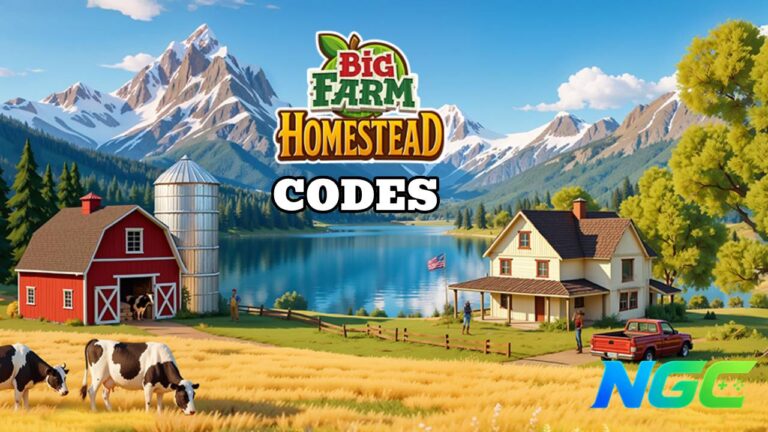
Big Farm: Homestead is a farming simulation game set in the American Midwest, where players restore old family farms and turn them into a thriving countryside homestead. You grow crops, raise animals, expand your land, upgrade buildings, and slowly rebuild the Townsend family farms, each with its own story, resources, and history.
All Working Big Farm Homestead Codes
Learn more about why a code may not work
Please let us know about any new or missing codes using the form below.Thanks for helping keep NewGameCodes up to date and accurate!
How to Get More Codes for Big Farm Homestead?
The easiest way to find new codes is to bookmark this page and visit it from time to time. We keep this list updated with the latest working codes as soon as they become available.
You can also follow the game on Facebook and Discord, where developers may post new codes during events, updates, and giveaways.
Codes Change History
Latest updates for this pageHow to Redeem Codes in Big Farm Homestead?
Follow these steps to redeem working codes and claim your rewards.Expired codes
These codes have expired and no longer workWhen will new codes for Big Farm Homestead be released?
Our prediction based on past updatesGuide & Tips for Big Farm Homestead
Helpful tips to progress faster, spend resources wisely, and avoid common mistakes.In Big Farm Homestead, leveling up is not always pure progress. Every new level can unlock new products, and the Market may start asking for them before your farm can produce them smoothly. In the early and mid game, it is usually better to grow your farm’s production base before pushing every XP reward right away.
A good habit is to collect story quests when needed, but leave some regular task rewards unclaimed until you are ready for the next unlock. This helps you avoid the common XP trap: reaching a new level, seeing new Market demands, and then realizing you do not have enough buildings, workers, materials, or stock to keep up.
The Market is one of the most important systems in the game, but bigger-looking contracts are not automatically better. Before sending a contract, check what products it asks for and what materials it gives. Easy products like corn, milk, soybeans, or canned corn can be spent more freely, while harder products should be saved for contracts that give your most needed materials.
This avoids a painful mistake: wasting rare or slow goods on low-priority rewards. If a contract asks for something hard to replace and only gives a material you do not urgently need, trashing it is often the smarter move. Another contract will come, and keeping your stock healthy matters more than clearing every order.
Your Barn is not just extra storage. As you progress, contracts, barges, and later train crates can ask for amounts based around your storage capacity. If your Barn is behind, you may get requests that are awkward or even impossible to fill properly.
Make Barn upgrades a real priority, especially once materials start appearing in contracts. The mistake to avoid is spending all your Glass, Bricks, or other upgrade materials on smaller comfort upgrades while your storage stays too low. A weak Barn makes every other system feel worse.
Houses and Homestead upgrades give you workers, but houses can lower Happiness. Decorations bring Happiness back up. This matters because negative Happiness increases production costs, which slowly eats into the coins you need for buildings, upgrades, and expansion.
Do not cover your farm with decorations at the cost of useful space, but also do not ignore Happiness until it drops deep into the negative. In most cases, keeping a healthy middle range is better than chasing either extreme. The mistake is building only for workers and then wondering why production feels expensive.
Gems are useful because they can buy things that change how your farm plays, especially extra Market contract slots and production storage slots. Those upgrades give you more flexibility every day. Spending gems to skip short timers usually gives you only a tiny one-time benefit.
For F2P and low-spend players, the safest rule is simple: do not spend gems because you are impatient. Save them for upgrades that reduce pressure long term. The trap is buying a premium building or rushing timers early, then not having gems when an extra contract slot would help you choose better materials.
The Barge looks tempting because it gives materials, but it also forces you to fill every crate before you can send it. That can drain products you may need for better Market contracts. For many players focused on growth, the Market is usually more controlled and more efficient.
Use the Barge carefully, especially before your farm has strong production chains. The mistake is feeding it everything just because it is available. If the crates ask for products that slow your upgrades or expansion, it is fine to ignore the Barge for a while and focus on Market contracts instead.
Corn is not just a beginner crop. It feeds into early production chains like canned corn and cornbread, and weak basic production can make several later products harder to supply. The same idea applies to feed, milk, canned goods, and other chains as your farm expands.
Before adding too many new goals, make sure your simple goods are stable. Keep fields, feed production, and early processors working instead of chasing only the newest unlocked item. The mistake is building a farm that can make fancy products once, but cannot keep the basic ingredients flowing.