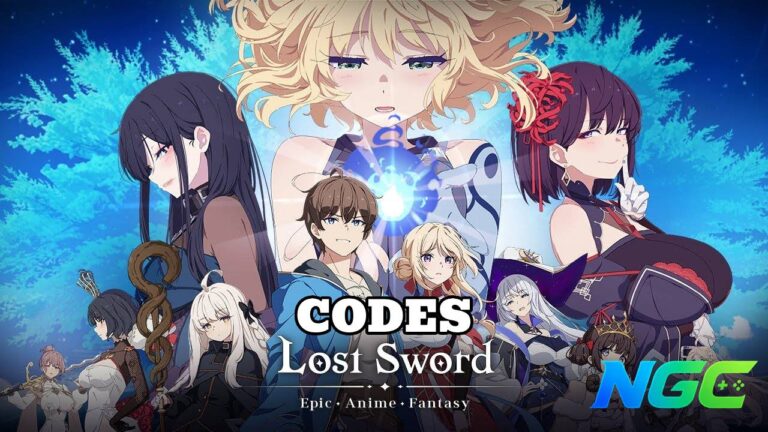
Lost Sword is an anime fantasy RPG that sends players on an otherworldly adventure in search of the legendary Holy Sword, Excalibur. The game combines 2D side-scrolling real-time battles, AFK progression, cinematic skill animations, and a cast of lively characters inspired by fantasy and Arthurian themes.
Players build a party of heroes, develop their team, clear dungeons and raids, and enjoy a story-driven journey filled with action, humor, and character chemistry. With high-quality anime illustrations, voiced characters, and flashy combat scenes, Lost Sword is designed for players who enjoy collectible RPGs with both visual style and steady progression.
All Working Lost Sword Codes
Learn more about why a code may not work
Please let us know about any new or missing codes using the form below.Thanks for helping keep NewGameCodes up to date and accurate!
How to Get More Codes for Lost Sword?
The easiest way to find new codes is to bookmark this page and visit it from time to time. We keep this list updated with the latest working codes as soon as they become available.
You can also follow the game on Facebook and Discord, where developers may post new codes during events, updates, and giveaways.
Codes Change History
Latest updates for this pageHow to Redeem Codes in Lost Sword?
Follow these steps to redeem working codes and claim your rewards.Expired codes
These codes have expired and no longer workWhen will new codes for Lost Sword be released?
Our prediction based on past updatesGuide & Tips for Lost Sword
Helpful tips to progress faster, spend resources wisely, and avoid common mistakes.In Lost Sword, duplicate characters are not just small stat boosts. Transcendence 3 and Transcendence 5 both give +1 Skill Level, while Awakening costs two duplicates and gives a flat stat increase. For most early and mid-game accounts, that means your first real goal should be getting one strong main DPS to important breakpoints instead of giving every useful unit a little bit of investment.
This avoids one of the biggest beginner traps: building a “balanced” roster that has no real carry. Supports and tanks often work well once they reach key utility breakpoints, but your main damage dealer is the unit that pushes story stages, bosses, raids, and damage thresholds. For F2P and low-spend players, full Awakening should usually wait until you know the unit is going to stay as your main carry for a while.
Lost Sword’s pity system is friendly compared with many gacha games: the 120-pull pity does not reset when you pull a 5-star, and pity carries between banners. Also, regular new units are added to the standard pool immediately, with collaboration units being the main exception. That makes random impulse pulling less necessary than it first appears.
The mistake this prevents is spending Gems halfway across several banners and never reaching the character you actually need. If you are early game, pull with a target: a strong DPS, a missing tank, a healer, or a pet that fixes your team. Since pity carries, stopping before 120 is not always a disaster, but pulling just because you have 2000 Gems is still a good way to delay real progress.
Lost Sword is an auto-battler, but team placement still matters. Front row gives a Defense bonus, while center and rear rows give Attack bonuses. The game also uses elemental advantage, where the right element can increase damage dealt and reduce damage taken by 30%. That is big enough to change whether a stage feels impossible or suddenly manageable.
The common mistake is sorting by combat power and assuming the highest number is always the best team. If your backline DPS is sitting in the wrong place, your tank is not benefiting from front placement, or your team is fighting into bad elements, you may lose even with higher CP. When you get stuck, try changing position and element coverage before spending rare resources.
Gear in Lost Sword has different rarities and special stat lines. Early on, it is fine to upgrade what you have just enough to keep moving, but pushing every random piece too far wastes resources. Percentage stats are usually much stronger than flat stats, and a piece with at least two good lines is a better temporary investment than a higher-rarity item with bad rolls.
Be especially careful with Stat Reroll Tickets. Their result is random, and a piece can go from useful to worse after a reroll. The safer approach is to hold rerolls for gear that already has long-term potential, not for every early item you equip for one chapter.
For account Growth, Attack is the safest priority because it helps damage dealers, buffers, and even healers. Boss Attack is much lower priority and can usually wait until the more universal stats are handled. For Specialties, damage dealers usually want ATK% and Crit Damage, tanks want HP% or DEF%, and healers often still care about ATK% because healing scales from offensive stats.
This prevents a quiet but expensive mistake: spending rare stones and gold on stats that look useful but barely move your account forward. Flat stats are generally weak compared with percentage stats, and Priority is mainly a PvP stat. Unless you are specifically building for PvP timing, do not treat Priority like a core PvE stat.
Training can give character-specific stats, but the big glowing passive nodes can boost your whole account. That makes Training very powerful over time. The catch is that Training uses valuable materials such as Elemental Stones, Souls, and Skill Pages, and the tree cannot be reset for a full refund.
For early and mid-game players, this means you should train units you expect to keep using. Fire and Electric characters can provide global ATK, Frost and Radiant can provide DEF, Chaos and Nature can provide HP, while Holy characters vary and should be checked individually. The mistake to avoid is dumping Training materials into a temporary unit just because they are in your current team today.
Avalon is not just “do your guild raid attempts.” Each player has 6 hits, there are 6 castles, and each castle has outer gate, inner gate, and boss stages. If everyone hits random castles once, your guild spreads damage too thin and misses better rewards from deeper progress.
The better habit is to check where your guild is focusing and spend your hits on the same targets. Even a F2P guild can score better when players coordinate around two castles instead of scattering across all six. This avoids wasting attempts in a mode where organization matters as much as raw whale power.