
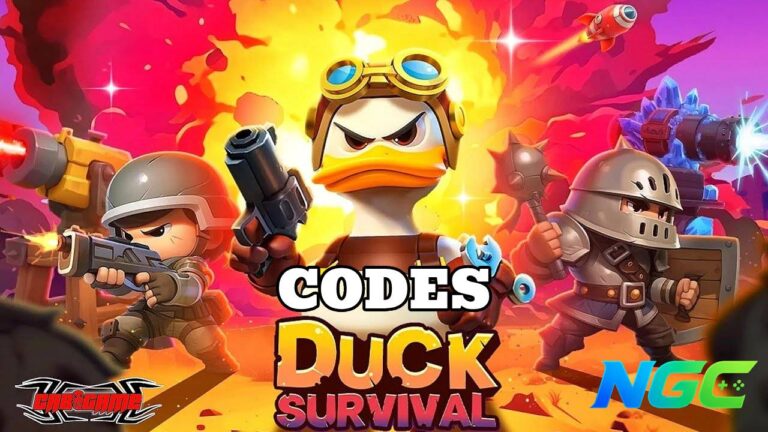
Duck Survival is a roguelike shooter and tower defense survival game where players control a brave duck fighting through a zombie apocalypse. The game is built around a clear day-and-night loop: during the day, you use resources to upgrade your base, recruit soldiers, and place defenses, while at night you defend your fortress from waves of mutated zombies and giant bosses.
All Working Duck Survival Codes
Learn more about why a code may not work
Please let us know about any new or missing codes using the form below.Thanks for helping keep NewGameCodes up to date and accurate!
How to Get More Codes for Duck Survival?
The easiest way to find new codes is to bookmark this page and visit it from time to time. We keep this list updated with the latest working codes as soon as they become available.
You can also follow the game on Facebook and Discord, where developers may post new codes during events, updates, and giveaways.
Codes Change History
Latest updates for this pageHow to Redeem Codes in Duck Survival?
Follow these steps to redeem working codes and claim your rewards.Expired codes
These codes have expired and no longer workWhen will new codes for Duck Survival be released?
Our prediction based on past updatesGuide & Tips for Duck Survival
Helpful tips to progress faster, spend resources wisely, and avoid common mistakes.During the day, do not spend all your resources on one type of upgrade. Duck Survival gives you time to strengthen the base, recruit soldiers, and place defenses before the zombie wave starts, so use that phase to cover both raw damage and crowd control. Machine Gun Towers are useful for steady pressure, while EMP Towers are important when fast or tougher enemies start reaching your fortress.
The mistake is treating daytime like a simple “buy the highest damage thing” phase. If your setup kills normal zombies but cannot slow or interrupt dangerous waves, the night can collapse quickly. In the early game, a balanced defense is usually safer than one overpowered tower with weak support around it.
Duck Survival has heroes and elemental types such as Burning, Lightning, Frost, Energy, and Physical. That means a team is not only about putting your rarest units together. In most cases, you want heroes and skills that activate useful synergies instead of a random mix of strong-looking characters.
This helps you avoid wasting upgrade materials on a team that looks powerful but does not work together. For F2P and low-spend players, this matters even more because resources are limited. A slightly lower-rarity hero that completes your main element setup can be more useful than a “better” hero that breaks your build.
Random skills appear during battle, and examples include Meteor Strike, Frost Shield, and Focused Laser. Do not always pick the flashiest damage option. If small zombies are flooding the screen, area damage is usually more valuable. If your base is barely surviving, defensive or control skills can buy enough time. If a boss is the real wall, focused single-target damage becomes more important.
The common mistake is choosing the same type of skill every run. Duck Survival is partly roguelike, so each night can push you into a different situation. Treat every skill choice as an answer to the current wave, not as a fixed build order.
When a night goes badly, look at how you lost. If zombies reached the fortress in large numbers, your issue is probably wave clear or slowing power. If only bosses survive, your single-target damage is likely too low. If enemies break through too early, your daytime upgrades may be too spread out.
This is better than randomly upgrading whatever has a red dot. Duck Survival’s loop is built around surviving nights to evolve your base, so every failed defense should guide your next day phase. The mistake is blaming hero power alone when the real problem is often tower placement, lack of control, or the wrong skill choices during the wave.
The game includes gear, gems, and other progression systems outside battle. Early on, it is usually smarter to focus these upgrades on the heroes and build you actually use every day, especially the units tied to your main element synergy or boss-killing plan.
Spreading upgrades across every new hero slows down your progress. This becomes painful when you reach tougher zombie waves or unlock modes where damage checks matter more. Until you understand which heroes fit your team, keep rare resources concentrated on your core lineup.
Duck Survival includes more than the main base-defense battles: there are dungeons, Guild Boss fights, and Arena PvP. These modes should not always be treated the same way. Base defense rewards wave clear and control. Guild Boss fights usually need stronger sustained or single-target damage. Arena often favors faster impact, control, and a team that can pressure opponents quickly.
The mistake is using one setup everywhere and assuming the game is just about total power. A build that survives zombie hordes may be too slow for Arena, while a boss-focused setup may struggle against large waves. Once you unlock more modes, adjust your skills and upgrades around the mode you are playing.
Duck Survival promotes large launch rewards such as free draws, a soldier duck skin, an Epic Gatling Gun, and banknotes. These rewards can give a strong early push, but they are still easy to waste if you upgrade every new pull immediately. First see which heroes, elements, and weapons actually support your main team.
This avoids the classic early-game trap: getting excited by many summons, then running out of resources before your build has a clear direction. Use free pulls to form options, not to upgrade everything. Once you see a real synergy forming, then start investing more seriously.